
Weber County Court Record Requests
The first stop is Utah Courts Xchange. It serves public District Court or Justice Court cases in Weber County. Court staff enter data into CORIS. Xchange displays it. Parties, the assigned judge, filings, and hearings can appear. So can judgments, disposition, account summary, and the chronological Proceedings. Documents filed in public District Court cases since July 1, 2010 may carry a purchase link. That applies when an electronic image exists. Treat the screen and its printable case history as indexes. Neither one is a clerk-certified copy.
Each access channel has its slot. Xchange costs a fee for public online use. Free public terminals sit in most District courthouses and the Utah State Law Library. You can also visit the originating clerk's counter. Or call the court for the right request route. Utah's written Request for a Record form can be mailed in. Pickup or mail delivery can be arranged. Email or fax carries its own charge and does not apply to records already sold through Xchange. Utah Courts eFiling serves authorized filers, not the public. MyCourtCase is free for parties, eligible participants, and eligible crime victims. It is not a public name index.
- Identify whether the case belongs to Weber County - Ogden District Court, a local Justice Court, or the Second District Juvenile Court.
- Use Xchange or a free public terminal to confirm the case number and exact document title.
- Call or visit the originating clerk when an image, older file, or case classification remains unclear.
- Describe the requested record with reasonable detail, choose inspection or copies, and state any right to non-public access.
- Ask for plain, certified, exemplified, audio, or transcript form as needed, then arrange fees and delivery with the clerk.
Weber County Court Records Custodians
The Weber County Clerk/Auditor does not hold every court file. Felony, class A misdemeanor, major civil, domestic, probate, guardianship, adoption, name-change, and Justice Court appeal files all sit with one clerk. That clerk works at Weber County - Ogden District Court. Each city or county Justice Court clerk keeps that court's traffic, infraction, ordinance, class B or C misdemeanor, and small-claims records. Juvenile delinquency and child-welfare files belong to the Second District Juvenile Court clerk. Access rules there are narrower.
Xchange is a repository, not the custodian of record. A Weber County result there still points back to the court location that entered it. County administrative records travel a separate path through the Weber County GRAMA process. Court pleadings, judgments, case histories, and certified court copies are different. They should go to Utah Courts. Or go to the local Justice Court that created the file.
Kinds of Court Records
A Weber County case history is just an index of events. The case file holds the papers behind those entries. Contents depend on case type and public status. Expect a complaint or petition, an answer, motions, notices, minute entries, signed orders, judgments, and available exhibits. Criminal files may hold charges, pleas, and dispositions. Civil and probate files can contain claims, responses, decrees, and appointment papers. Domestic records often mix a public case history and final orders with private filings underneath.
- Case summaries and chronological Proceedings from Xchange
- Filed complaints, petitions, answers, motions, and notices
- Minute entries, hearing records, orders, decrees, and judgments
- Public exhibits and electronically imaged court documents
- Certified or exemplified copies issued by the originating court
- Digital hearing audio and official transcripts ordered by separate routes
A citation may stay private while a redacted abstract of it goes public. The same split applies to dockets. The public docket can name an event. The paper behind it can stay restricted. So read the event list as a map to the file, not proof that each listed item can be downloaded.
Weber County Court Records Form
The written Utah Judiciary form asks which court receives it. It also wants that court's address and a reasonably specific description of the records. You choose inspection or copies and acknowledge possible fees. Anyone asking for non-public material must explain the basis. They might be the subject. They might have supplied the information. Others hold authorization under Rule 4-202.03, or something else applies. Identification and supporting papers may be required. The official Utah court-record request page walks through that workflow and its charges.
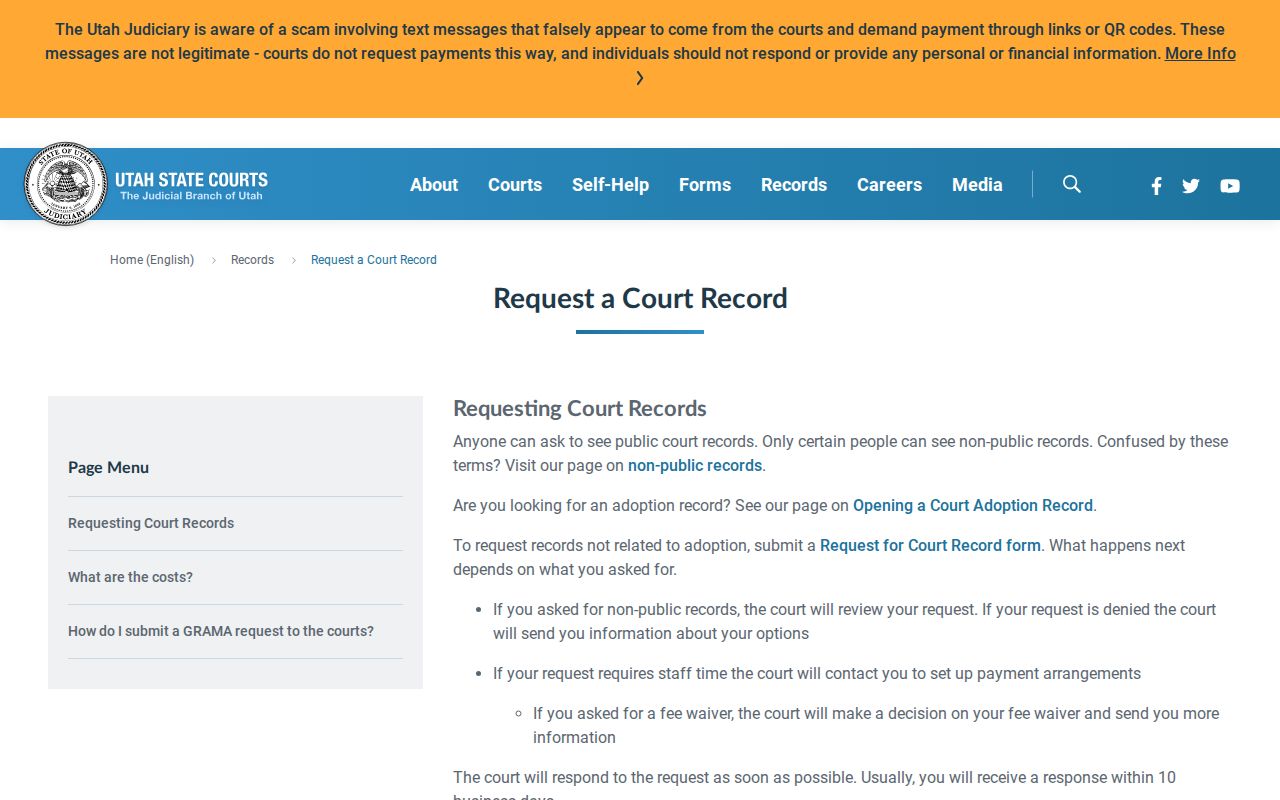
The screen helps a Weber County requester sort costs. It separates free inspection from copies, staff research, certification, and special delivery. Absent expedited treatment, the form warns that a decision may take up to ten business days. That window is a response period. A large or archived copy order may take longer. The deadline is not a fixed promise.
Court Records: What They Contain
Read the public file from identification through outcome. Utah case numbers open with the two-digit filing year. Yet a number is not unique statewide. Pair the Weber County court location with a number like 085502036. Then match each filing or setting in Proceedings to any available document. A purchase link means an image is offered. A case-number link only opens more history, so it does not itself retrieve the paper.
| Case Number | Identifies the case with court location and case type; the first two digits indicate the filing year. |
|---|---|
| Parties and Counsel | Lists public party roles, names, and attorneys when displayed. |
| Pleadings | Includes public complaints, petitions, answers, motions, and notices filed in the case. |
| Proceedings | Gives the dated sequence of filings, settings, minute entries, and court action. |
| Orders and Judgments | Shows court directions, decrees, disposition, and enforceable rulings that are public. |
| Documents | Offers a purchase link only when a public electronic image is available. |
Missing Weber County Court Record PDFs
A docket entry in Xchange with no document attached is not the same as a filing that never happened. Some Weber County court records simply have not been put into electronic form yet. Older Justice Court files may show only a converted summary. Each court started using CORIS at its own date. A gap can also come from restricted content. It may be a paper-only file, a file sitting offsite, or an event that was never imaged.
Write down the case number, the Weber County court location, the filing date, and the document title. Use each item as shown in Proceedings. Then phone the clerk of the court that received the filing, or bring those details to the counter. If staff cannot resolve the request informally, file the written form. Say whether you want to view the record, get a plain copy, or need certification. For an old case, ask if the file still sits at the court. It may have gone to Utah State Archives. Utah Courts notes that records more than fifty years old are often archived there.
Note: A missing electronic image is a reason to contact the clerk, not proof that a public filing is unavailable.
Copy Fees and Certification
A plain copy just reproduces the record the court has on hand. A certified copy is different. The originating court adds its certification when a requester has inspection rights, names the item with reasonable specificity, and pays the required fee. An exemplified copy goes further and carries added authentication. Keep in mind that Xchange's $1 document purchase is neither certification nor exemplification, and confirm current amounts before paying, since the live and published Xchange materials have shown inconsistent search pricing.
| Record service | Current published amount |
|---|---|
| Public inspection | No charge |
| Paper copy | $0.25 per sheet |
| Email or fax | $5 through 10 pages, then $0.50 per page; not for records on Xchange |
| Xchange document | $1 per document |
| Certified copy | $4 per document plus $0.50 per page |
| Exemplified copy | $6 per document plus $0.50 per page |
| Audio or video copy | $15 per half day of testimony |
Weber County - Ogden District Court Clerk
2525 Grant Avenue
Ogden, UT 84401
(801) 395-1079
Weber County Court Record Audio
Hearing audio does not arrive through a normal Xchange document link. Utah state courts use digital audio. A few locations add video. Direct your audio request to the judicial services representative at the District or Justice Court. That is the court where the hearing took place. The form wants the county, the court, the case caption and case number, the judge or domestic commissioner, the courtroom, dates, times, your own details, and how you want delivery.
Options run from an email link or an emailed MP3 to an electronic storage device. Mail and pickup are also possible. Processing is stated as within ten business days after payment. A pickup copy left uncollected for thirty days is destroyed. For a written record, an official transcript follows the Utah Courts transcript process. Payment is arranged through the assigned transcriber. Once it is prepared and paid, the certified transcript and PDF are filed with the trial court and sent to you. Build a transcript any other way and it is not an official court transcript.
Access Rules for Court Records
Utah presumes its court records are public. A rule, a law, or a court order must say otherwise. Plenty of material sits outside ordinary Xchange content. Sealed and expunged files fall in that group. So do Juvenile Court legal and social records, adoption and civil-commitment files, child-welfare and termination matters, private domestic filings, medical material, and personal identifiers. A citation stays private, though a redacted abstract may be public. So an empty Weber County docket search can point to the wrong court, an old conversion, or a restricted class. It does not always mean a case does not exist.
Key Utah access rules:
UCJA Rule 4-202.02 sets public, private, protected, sealed, safeguarded, and juvenile classifications.
UCJA Rule 4-202.04 governs written requests and proof of entitlement to non-public material.
UCJA Rule 4-202.09 addresses certification, redaction, accuracy, and retention.
Utah Code 63G-2-301 treats judicial records as public unless court rules, orders, or private classifications restrict them.
A requester with authorized access should hand the clerk identification plus the papers that back up the claim. If access is denied, Rule 4-202.07 provides an appeal route. And remember that the court itself decides the classification, not Xchange and not a county administrative office.
Older Weber County Court Record Layers
Weber County court history now runs through several layers. There are paper indexes, local Justice Court conversions, CORIS summaries, imaged filings, and archived records. Most Utah District Courts were on CORIS by the end of 1998. Justice Courts converted at different times, though. So a newer District Court case can carry a rich electronic case history. An older local case may show only a few entries. That difference reflects the record system in use, not necessarily the amount of court activity behind it.
Start with the court that created the record. Ask whether the original still sits local, exists as microfilm or a bound docket, survives only as a converted summary, or has already moved. The Utah Court Records overview notes that records older than fifty years are often held by Utah State Archives. The originating clerk is still the sound first contact. The court's location and retention history control where the file ended up.